nuestra puntuaciónsin valoraciones de usuarios - valore →
Análisis de Self-hosted WireGuard on a cheap VPS
No es un servicio de VPN, sino el protocolo sobre el que toda VPN comercial desea estar construida, y el protocolo de túnel con mayor respaldo de evidencia existente. Usted es el proveedor: genere claves, ejecute wg-quick en un VPS de cinco dólares o en una Raspberry Pi, y no hay ninguna empresa a la que citar judicialmente, ninguna política de privacidad en la que creer, ni registros a menos que usted los escriba personalmente. Las pruebas son inusuales incluso según los estándares del software libre: aproximadamente 4.000 líneas de código frente a 600.000 de OpenVPN+OpenSSL, cuatro análisis formales/independientes de seguridad (prueba simbólica Tamarin, prueba computacional eCK, prueba de INRIA con CryptoVerif del protocolo completo incluyendo transporte de datos, y el modelo ProVerif Noise-IK), código de Curve25519 verificado por máquina, una auditoría externa limpia antes de la versión 1.0, y presencia en el kernel principal de Linux desde la versión 5.6 (incorporación en enero de 2020, lanzamiento en marzo de 2020). Los compromisos son estructurales, no incidentales: solo UDP con un intercambio inicial identificable (Rusia comenzó a bloquear conexiones OpenVPN/WireGuard en 2024; AmneziaWG existe precisamente por esto), la gestión de claves es completamente responsabilidad suya, el túnel dividido por proceso es lo suficientemente torpe como para que usuarios de HN lo consideren un gran problema de usabilidad, y el cliente para Windows depende de la firma de controladores de Microsoft (la finalización de una firma en abril de 2026 obligó a un lanzamiento de emergencia). Tampoco le anonimizará nunca ante su propio proveedor de VPS o su ISP doméstico: una IP de salida autohospedada es simplemente su propia identidad en un lugar nuevo.
AuditoríaCódigo abierto4 señales de alertaHechos verified - live-fetched 2026-11-03: wireguard.com (home, install, protocol, formal-verification, repositories), IACR ePrint 2018/080, noiseexplorer.com IK analysis, Wikipedia, Ars Technica (2018 review + 2020 kernel-5.6 report), Cloudflare BoringTun blog, GitHub API metadata for WireGuard/wireguard-tools, HN Algolia comment and story search, and the r/WireGuard arctic-shift archive (body-search endpoint returned HTTP 400; the plain listing endpoint was used instead). wireguard.com/papers/ returned HTTP 403 to our fetcher and the whitepaper PDF is not text-fetchable, so whitepaper facts are cited from the project's formal-verification page. Tailscale's 'why WireGuard' post 404s at its old URL; hal.inria.fr sits behind an Anubis bot-check.
The formal proofs cover the HANDSHAKE and primitives, not your deployment: Dowling-Paterson prove a minimally modified variant (the eCK paper notes WireGuard's key confirmation makes the exchange 1.5-RTT and rules out a clean proof of key indistinguishability), and every proof assumes you did key distribution correctly - the code you run and the keys you manage sit outside all of it
Identity hiding is conditional: per the operator's own formal-verification page, when the responder's static key is compromised WireGuard does not achieve identity hiding - the initiator's identity is protected, the server's is not
State-level censorship treats vanilla WireGuard as protocol enemy #1: Russia blocked OpenVPN/WireGuard in 2024 (HN), and 2026 reporting from Iran documents WireGuard tunnels with limited success against heavy filtering (Wikipedia/Iran International) - if censorship resistance matters, the core protocol alone is not enough
+1 señales de alerta más - desplegar antes de registrarse
Single-maintainer bus factor: the project, codebase and trademark belong to one person (Jason A. Donenfeld / ZX2C4); official GitHub repos are mirrors with issues disabled, bug reports go to a mailing list - healthy for focus, fragile for succession
Análisis
Borrador de Qwen3, verificado por la redacción de serviciovpn · Versión del análisis 7 · Texto actualizado 2026-11-03 · Hechos a fecha de 2026-11-03 · cómo verificamos
Nota de honestidad: no hemos hecho tests propios de Self-hosted WireGuard on a cheap VPS (fugas, velocidad, kill switch). Todo en esta página es metainvestigación basada en fuentes con enlaces fechados. En cuanto hagamos pruebas, los resultados aparecerán aquí y en el registro de cambios.
Overview
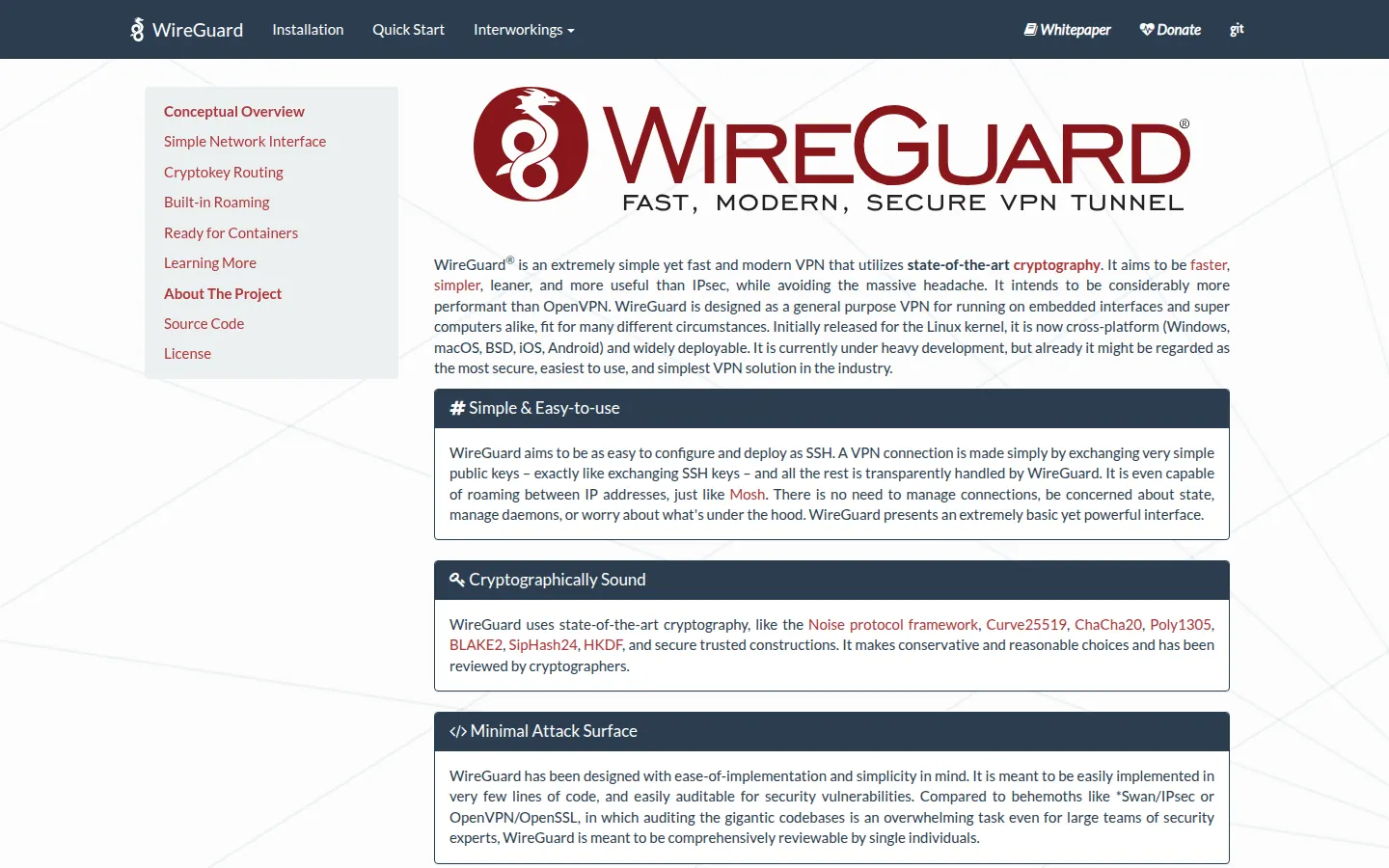
Self-hosted WireGuard on a cheap VPS homepage - live capture 2026-09-29
Self-hosted WireGuard on a cheap VPS isn't a commercial VPN - it's you running the protocol on infrastructure you control. There's no provider to trust, no privacy policy to parse. You are the operator: generate keys, deploy on a $5/month VPS or a Raspberry Pi, and eliminate third-party logging by design. The caveat? You inherit full responsibility for security, uptime, and key management.
Logging & privacy
WireGuard logs nothing by design - the protocol is stateless, and the reference tools don’t persist connection data. Any logging occurs only if you configure it on your own server. There’s no privacy policy to audit because there’s no central entity. The evidence isn’t a corporate audit but formal verification: symbolic (Tamarin), computational (eCK, CryptoVerif), and machine-checked proofs confirm handshake security, forward secrecy, and key agreement. However, identity hiding fails if the server’s static key is compromised. Jurisdiction is irrelevant - there’s no operator to subpoena.
Pricing & the renewal trap
The WireGuard software is free (GPL/MIT/BSD-licensed); you pay only for the infrastructure - typically around $5/month for a VPS, or less (some HN users report ~$2/year for minimal boxes). There is no renewal trap because there is no billing - no intro price, no renewal, no contract. You control the machine, so costs depend entirely on your hosting choice. The derived_pricing fields are null because this is not a subscription service.
Features & performance
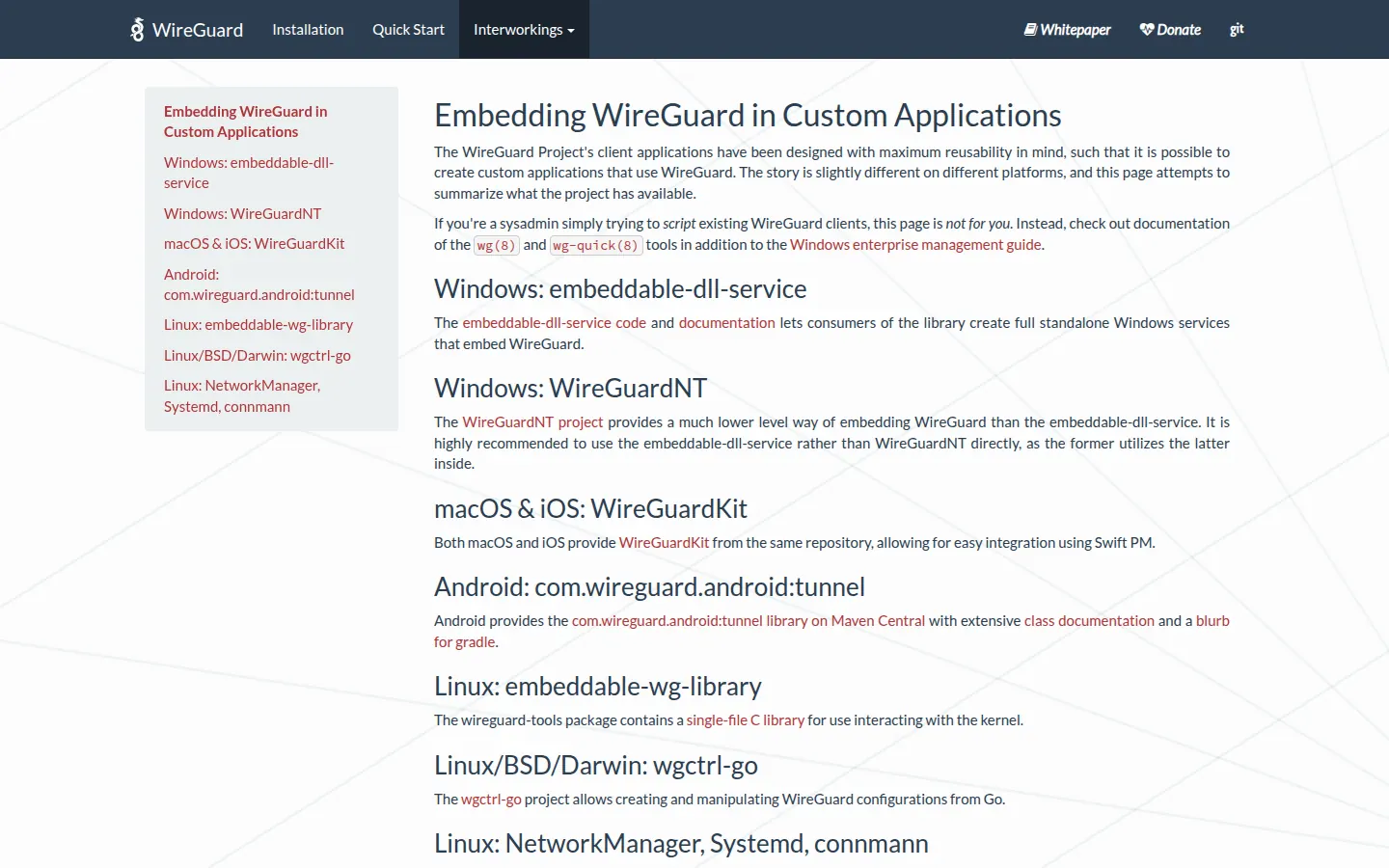
Self-hosted WireGuard on a cheap VPS apps / download page - live capture 2026-09-29
WireGuard uses its own protocol (Noise_IKpsk2 over UDP) with ChaCha20, Curve25519, and BLAKE2s. It has no built-in kill switch, multihop, or obfuscation. Split tunneling is possible but clunky on some platforms. It supports all major OSes and routers. There are no central servers - your deployment defines performance. Independent reports show multi-gigabit throughput on capable hardware. P2P and streaming aren’t direct features, but the tunnel can carry any IP traffic. Performance is high due to kernel integration and minimal code (~4,000 lines), but we have not run our own tests.
Ownership & track record
WireGuard was created and is maintained by Jason A. Donenfeld (ZX2C4), who holds the copyright and trademark. It has no corporate owner. The project is hosted on GitHub as mirrors only; bug reports go to a mailing list. Red flags include a single maintainer (bus factor risk), no issues on official repos, and dependency on third parties (e.g., Microsoft’s driver signing, which caused an emergency Windows release in April 2026). Despite this, it has a decade of strong reputation: Linux kernel inclusion (5.6, 2020), formal proofs, and endorsements from Torvalds and Senator Wyden.
Censorship resistance
Vanilla WireGuard has no obfuscation - the handshake is simple and easily fingerprinted over UDP. Russia began blocking OpenVPN/WireGuard in 2024, and Iran’s 2026 filtering limited its effectiveness. It is not suitable for high-censorship regions without modification. Third-party forks like AmneziaWG add obfuscation to resist DPI, but the core protocol alone is not censorship-resistant.
Verdict
If you self-host, WireGuard is the gold standard: minimal, fast, and backed by more cryptographic evidence than any commercial VPN. It’s ideal for homelabbers, developers, and privacy-focused users who already run infrastructure. But it’s not turnkey - expect to manage keys, firewalls, and updates. There’s no money trail: WireGuard doesn’t pay review sites, and it has no affiliate program.
++ Qué se sostiene
Verificado formalmente de cuatro maneras independientes: prueba simbólica Tamarin, prueba computacional eCK, prueba INRIA CryptoVerif del protocolo completo incluyendo mensajes de datos de transporte, modelo ProVerif Noise-IK (página oficial de verificación formal, IACR ePrint, Noise Explorer - todos obtenidos el 2026-11-03)
Aproximadamente 4.000 líneas de código frente a 600.000 de OpenVPN+OpenSSL: superficie de ataque que una persona puede revisar realmente (Ars Technica 2018, obtenido en tiempo real)
En el kernel principal de Linux desde la versión 5.6 (fusionado en enero de 2020, lanzado en marzo de 2020): módulo de kernel de primera parte, sin necesidad de reconstrucciones DKMS (Ars Technica 2020)
Sin estado: no existen registros a menos que el operador los configure; al no haber proveedor, no hay destinatario para citaciones ni políticas que cuestionar (documentación del protocolo del operador)
Funciona en cualquier cosa: paquetes oficiales para Windows/macOS/iOS/Android/BSDs/OpenWRT más una implementación en espacio de usuario Go; usuarios de HN ejecutan pares en VPS con 128 MB de RAM (página de instalación + voces de HN obtenidas el 2026-11-03)
Conexiones instantáneas: aproximadamente 100 ms para conectarse frente a más de 8 segundos para OpenVPN en las pruebas de Ars Technica (reseña de 2018)
Linus Torvalds sobre el código: comparado con OpenVPN e IPsec, 'es una obra de arte' (LKML, citado en la reseña de Ars obtenida)
-- A qué prestar atención
Solo UDP y trivialmente identificable: sin ofuscación en el núcleo; Rusia comenzó a bloquear conexiones OpenVPN/WireGuard en enero de 2024 (hilo de 439 comentarios en HN) y AmneziaWG es un fork completo creado para corregir esto
La gestión de claves depende completamente de ti: generación, rotación, distribución y mantenimiento de AllowedIPs por par, sin panel de control en wg-quick
Delimitar una VPN a un subproceso es incómodo: HN: 'WireGuard tiene grandes problemas de usabilidad debido a eso'; existen soluciones alternativas como wireproxy (HN, octubre de 2026)
La distribución en Windows depende de la firma de código de Microsoft: en abril de 2026 Microsoft terminó la cuenta de firma y WireGuard lanzó una versión de emergencia (hilo HN 47719942)
La calidad del puerto varía fuera de Linux: el soporte en modo kernel fue retirado de FreeBSD 13.0 en 2021 antes de ser reintroducido mediante paquetes pfSense (Wikipedia, obtenido el 2026-11-03)
No tiene valor para desbloqueo geográfico: tu IP de salida es tu propia IP de VPS o doméstica, por lo tanto no hay cambios en catálogos de streaming ni IPs limpias compartidas
Prueba de realidad de precios
Precio inicial
5,00 US$ /mo
Notas
El protocolo y todas las implementaciones de referencia son gratuitas. La cifra de 5 USD es una presentación de este sitio: un VPS barato (alrededor de 5 USD/mes) o una Raspberry Pi en casa es todo lo que necesitas para ejecutar tu propio servidor WireGuard. Voces de HN (obtenidas el 2026-11-03) ejecutan regularmente pares WireGuard en ofertas VPS ultrabaratas; uno describe unos pocos dólares por AÑO por una máquina con 128 MB de RAM ejecutando Alpine que sirve como par WireGuard y además un pequeño sitio web.
El flujo de dinero - lo que ganan los portales de análisis con esta recomendación
Estado de afiliación aún sin verificar
Si nos uniéramos a este programa, cada enlace de aquí llevaría rel="nofollow sponsored" y pasaría por /go/. Hasta entonces, nuestros enlaces apuntan directamente al sitio del proveedor, sin ningún rastreo. La lógica de ordenación no puede leer físicamente los campos de afiliación - aquí la prueba.
On the website
Captured by our screenshot bot from the live site (or its public archive). A capture is evidence of what the page showed at capture time - not an endorsement.
Self-hosted WireGuard on a cheap VPS homepage - live capture 2026-09-29Self-hosted WireGuard on a cheap VPS apps / download page - live capture 2026-09-29
Antes de pagar: compruebe el precio de renovación, el plazo de reembolso y si un camino más barato o gratuito cubre su caso de uso - la lista honesta.
Estado de nuestras comprobaciones: 2026-11-03. Self-hosted WireGuard on a cheap VPS alcanza 4/10 en nuestro análisis ponderado. Hemos registrado 4 señales de alerta (listadas arriba). Los reportes de usuarios, la propiedad y el historial de incidentes están documentados con fuentes fechadas en el metaanálisis de abajo.
What do I actually get?
You get free, open-source software to create encrypted tunnels. You run it on your own server - no accounts, no data caps, no provider. Everything from key generation to uptime is your responsibility.
What is the renewal price and total 3-year cost?
There is no renewal price. The software is free. Your cost is only the VPS or hardware - around $5/month typically. The three_year_cash_total is null because pricing depends entirely on your hosting choice.
What evidence supports the no-logs claim?
There are no logs because the protocol is stateless and the tools don’t record connections. The evidence isn’t a policy or audit - it’s structural: no operator exists to log. Formal verification confirms cryptographic soundness, but deployment security is yours to maintain.
Does it work in censored countries like China or Iran?
Not reliably. The core protocol has no obfuscation and is easily blocked. Iran and Russia have filtered WireGuard since 2024. Use obfuscated forks like AmneziaWG if censorship resistance is required.
Can I pay anonymously?
There’s no payment at all - the software is free. But your VPS provider may require ID. For anonymity, use a provider that accepts cryptocurrency and doesn’t enforce KYC.
What happens if the project shuts down?
The code is open-source and already in the Linux kernel, FreeBSD, and OpenBSD. Even if development stops, it will remain usable. The main risk is the single maintainer, but the codebase is small and well-understood.
What’s the honest free or cheap alternative?
WireGuard itself is free. For a managed option, consider Mullvad or IVPN - both are independent, audited, and support direct WireGuard profile use. Or run your own on a $5 VPS - cheaper than any commercial plan.
El metaanálisis: lo que internet dice de Self-hosted WireGuard on a cheap VPS
No esperamos que nos crea. Este análisis es un metaanálisis: abajo verá lo que afirman otros portales de análisis - con sus conflictos de interés señalados -, lo que reportan los usuarios en Reddit y foros y quién opera realmente Self-hosted WireGuard on a cheap VPS. Cada afirmación enlaza su fuente para que pueda comprobarla usted mismo.
Lo que dicen otros testers (2)
Cada fuente lleva una etiqueta de conflicto de nuestra base de datos de portales de análisis. «Financiado por afiliación» significa: la web gana si usted compra lo que recomienda. Las voces críticas las incluimos deliberadamente.
Fetched 2026-11-03 (HTTP 200): independent hands-on technical review - about 4,000 lines of code vs 600,000 (OpenVPN+OpenSSL) and 400,000 (XFRM+StrongSwan); quotes Linus Torvalds' LKML praise ('compared to the horrors that are OpenVPN and IPSec, it's a work of art'); measured connect time of about 100 ms vs 8+ seconds for OpenVPN on the same path; explains crypto versioning over agility and the optional PSK layer for post-quantum resistance; notes the author got direct Q&A from Jason Donenfeld after publishing configs; 'maybe faster, almost certainly more secure, and definitely a great deal simpler'.
Fetched 2026-11-03 (HTTP 200): engineering analysis from an independent implementer - WireGuard 'built around the Noise Protocol Framework', only a few modern primitives (X25519, ChaCha20-Poly1305, Blake2s); simplicity 'means it is more robust than old, unmaintainable codebases, and can also be implemented relatively quickly'; Cloudflare benchmarked wireguard-go far below the kernel module and chose Rust for memory safety; 'we believe it has a chance of being the defacto standard for VPN-like technologies going forward'.
Lo que dicen los usuarios (4)
Reddit, foros, HN - parafraseado y enlazado, nunca fuera de contexto. Anécdotas, no pruebas - pero las quejas de reembolso y los reportes de fugas son el mejor sistema de alerta temprana que tiene este mercado.
Fetched 2026-11-03 (HTTP 200): 11,449 matching comments. Recent 2026 voices span the self-host framing (a 2-dollar-a-year VPS as a WireGuard peer; '$0 for Wireguard'), protocol praise ('the simplicity. A small codebase can implement it'), usability criticism (per-subprocess scoping, wireproxy workaround), WireGuard-as-best-practice for admin interfaces, and providers being selected for accepting a plain WireGuard profile.
Fetched 2026-11-03 (HTTP 200): 1,011 matching stories - the milestone threads: 'WireGuard is now in Linus' tree' (982 pts, 278 comments, Jan 2020), 'WireGuard 1.0 for Linux 5.6' (768 pts, submitted by zx2c4 himself, Mar 2020), 'Response to WireGuard: great protocol, but skip the Mac app' (926 pts, 376 comments, Jan 2021 - Donenfeld's mailing-list rebuttal), 'WireGuard Gives Linux a Faster, More Secure VPN' (Wired, 741 pts, Mar 2020), 'Wireguard FPGA' (640 pts, Oct 2025), 'GotaTun - Mullvad's WireGuard Implementation in Rust' (632 pts, Dec 2025), 'Tell HN: Russia has started blocking OpenVPN/WireGuard connections' (439 pts, Jan 2024), self-host classics ('Setting up a home VPN server with WireGuard' 616 pts 2019; 'Build your own private WireGuard VPN with PiVPN' 552 pts 2023), and the Apr 2026 Microsoft signing-resolution thread (549 pts).
Fetched 2026-11-03 (HTTP 200; the body-search variant with body= parameter returned HTTP 400, so the plain listing endpoint was used): 25 recent r/WireGuard comments covering self-host threat-model questions (public WiFi/MITM visibility of your home IP), CGNAT/roaming pain on cellular (AT&T stale tunnels, tower-to-tower IP changes, keepalive workarounds), router performance measurements (BPI-R4 1.6 Gbps CPU-bound vs 2.4 Gbps on x86, IPsec comparison), community-built key-connect logging on OpenWrt, internal AD/DNS over the tunnel, and the TCP-fallback question.
Fetched 2026-11-03 (HTTP 200): 735 stars, 325 forks, GPL-2.0, language C, last push 2026-05-06; description reads 'Mirror only. Official repository is at https://git.zx2c4.com/wireguard-tools'; has_issues:false, has_discussions:false, has_pull_requests issue-creation disabled - the official GitHub presence deliberately redirects all bug reports to the mailing list, confirming the project's single-maintainer, mailing-list-driven workflow (open issue count field reflects the disabled tracker).
Informe de hechos con IA - todo lo que sabemos, condensado
Generado por Qwen3 el 2026-11-03 a partir de nuestra base de datos de hechos y las fuentes enlazadas. Resume - no añade hechos. Contraste todo lo importante con las fuentes enlazadas.
Bottom line: This is not a VPN service but a protocol you run yourself. You are the provider: no third party, no logs by design, but full responsibility for setup, key management and server upkeep. Performance and security are excellent, but it offers no built-in obfuscation or censorship circumvention.
The logging truth: No logs exist unless you configure them - logging is structurally impossible at the protocol level. Jurisdiction is irrelevant: there is no operator to subpoena, only your own server and keys. The evidence is formal verification (Tamarin, eCK, CryptoVerif), not audits of a company.
Pricing reality: The software is free. You pay only for the hardware - typically $5/month for a VPS or a few dollars per year for a low-end box. No renewal traps, no billing - just your infrastructure costs.
What reviewers say vs what users say: Reviewers (Ars, Cloudflare) praise its elegance, speed, and minimalism - calling it a “work of art” and future standard. Users agree on security and performance but highlight usability pain: split tunneling is clunky, per-process routing requires workarounds, and Windows depends on Microsoft’s signing. No conflict - both sides align on strengths and trade-offs.
Who runs it: Jason A. Donenfeld (ZX2C4) alone owns the code, trademark, and project direction. GitHub is a mirror; development happens via mailing list. This ensures focus but creates a single point of failure.
Fuentes & cómo se hizo este análisis
Cada fuente externa usada en esta página, con su fecha de consulta y su clase de prueba [A]-[D] (A = fuente primaria/del operador, B = prensa seria/investigación, C = comunidad, D = mediciones propias). Metodología: cómo verificamos. Las fuentes desaparecen o cambian - si un enlace está muerto, avísenos por la página de contacto.
Evidence classes on this page:[A] A: 6[B] B: 7[C] C: 4[D] D: 0(D stays empty until our own test phase)
The most credible self-hosting on-ramp in the VPN space, built by and for people inside the censorship: the app is free and open source, you connect it to your…
auditadoCódigo abierto
Inicial: 5,00 US$ /mo
Cyprus (EUPHORIATECH LIMITED, Nicosia, reg HE 484287 per site footer, verified 2026-11-02; IP rights in Portugal with Amnezia LDA, ops in Estonia) - for self-hosted users the operative jurisdiction is wherever their own VPS is hostedvpn autohospedado hace 3 días
The gold standard for connecting your OWN devices, and a poor substitute for a consumer VPN - which is exactly what it says on the tin. Tailscale is a…
AuditoríaCódigo abierto
Inicial: 8,00 US$ /user/mo
Canada - Tailscale Inc., Toronto, Ontario (Wikipedia, Bloomberg); a Five Eyes member country; privacy policy names processing locations in Canada, Germany, the US and the UKvpn autohospedado hace 3 días
The incumbent of self-hosted business VPNs, and still a safe pick in 2026 - with one honest fork in the road. Access Server is the polished, supported way to…
AuditoríaCódigo abierto
Inicial: 7,00 US$ /mo
United States - OpenVPN Inc., Pleasanton, California (about page fetched 2026-11-03); a Five Eyes member countryvpn autohospedado hace 42 h




Aún no hay comentarios - sea el primero. Publicar pasa por una breve prueba de trabajo en su navegador (antispam), sin necesidad de cuenta.