nuestra puntuaciónsin valoraciones de usuarios - valore →
Análisis de VPN Gate (public volunteer relay experiment)
VPN Gate is a legitimate, transparently-run academic experiment that is genuinely free forever and genuinely useful for one thing: getting past government firewalls from censored networks, which is exactly why its users are concentrated in China, Iran and Russia. It is also one of the least privacy-friendly VPNs in existence - by its own published policy it keeps 3+ months of connection logs including your real IP and the destination hostnames you visit, hands them to police, prosecutors, lawyers and courts, and publishes a live feed of connections; every volunteer relay additionally sniffs two weeks of TCP/IP headers on untrusted hardware. Speeds and uptime are luck-of-the-draw because ~100 volunteer relays (measured 2026-11-03, against a '6000+' marketing line) come and go, and users in censored countries report the network is actively blocked. Use it as a free research tool or emergency censorship escape hatch - never for anything you would not be comfortable having logged and disclosed.
AuditoríaCódigo abierto5 señales de alertaHechos verified - operator pages (homepage, overview, about, FAQ, anti-abuse policy, live activity logs, download, join) and the live server-list API were fetched directly 2026-11-03; GitHub SoftEtherVPN repo API, Wikipedia, USENIX NSDI'14 paper page, Security.org review and SoftEther user-forum threads fetched live; Reddit content returned HTTP 403 at network level and was read via the arctic-shift archive API; the Guido Vranken 2018 audit blog returned 403 to our fetcher and is cited from its title plus the HN listing
The logging design defeats the stated anonymity purpose for many users: a 2013 SoftEther-forum thread titled 'Logging defeats privacy and purpose of VPN' shows even early users understood that destination-hostname logging plus log disclosure to police turns the anonymity claim into a nullity - the policy has kept those clauses since
Volunteer-server trust model: anyone can host a relay; the anti-abuse policy's own mitigation is to tell victims to find the volunteer's contact address or go through the ISP - there is no vetting, and malicious or compromised relays are a structural risk
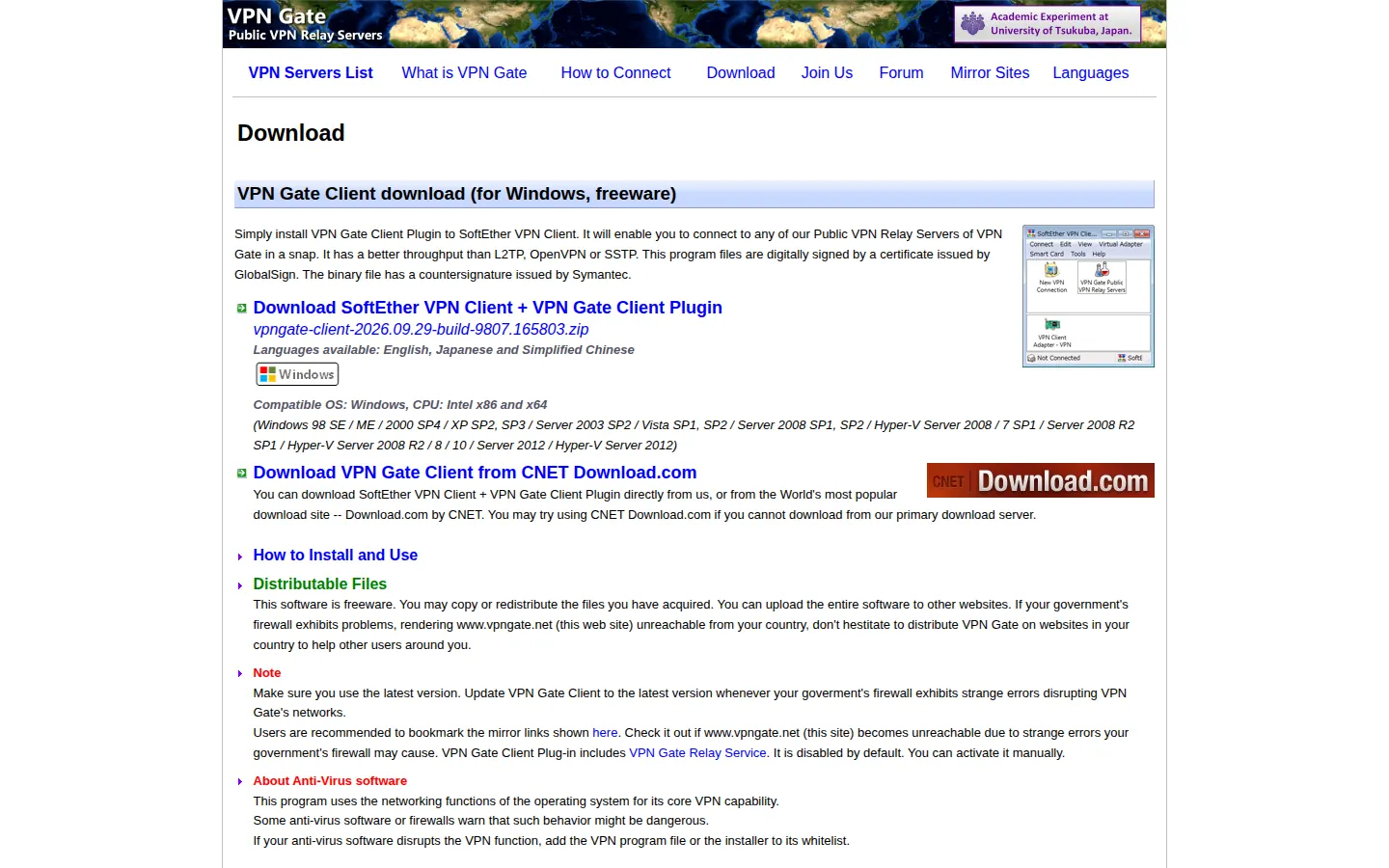
2018 independent audit of the underlying SoftEther stack (Guido Vranken) found 11 security vulnerabilities; SoftEther/VPN Gate clients are periodically flagged by antivirus vendors, to the point that the download page carries an 'About Anti-Virus software' whitelisting plea
+2 señales de alerta más - desplegar antes de registrarse
Jurisdiction and posture: the project states it 'can cooperate with the authority' to restrict VPN Gate use from a region if a government requests it under local law (about_us.aspx), and complies with Japan's specified-telecommunications takedown statute - it is not a resistance service in any legal sense
2026 blocking wave: a March 2026 SoftEther-forum thread shows users (self-identified from Russia and elsewhere) suddenly unable to reach most relays, with staff confirming 'your government is blocking VPNs' and recommending Tor or self-hosted VPS tunnels instead
Análisis
Borrador de Qwen3, verificado por la redacción de serviciovpn · Versión del análisis 2 · Texto actualizado 2026-11-07 · Hechos a fecha de 2026-11-03 · cómo verificamos
Nota de honestidad: no hemos hecho tests propios de VPN Gate (public volunteer relay experiment) (fugas, velocidad, kill switch). Todo en esta página es metainvestigación basada en fuentes con enlaces fechados. En cuanto hagamos pruebas, los resultados aparecerán aquí y en el registro de cambios.
Overview
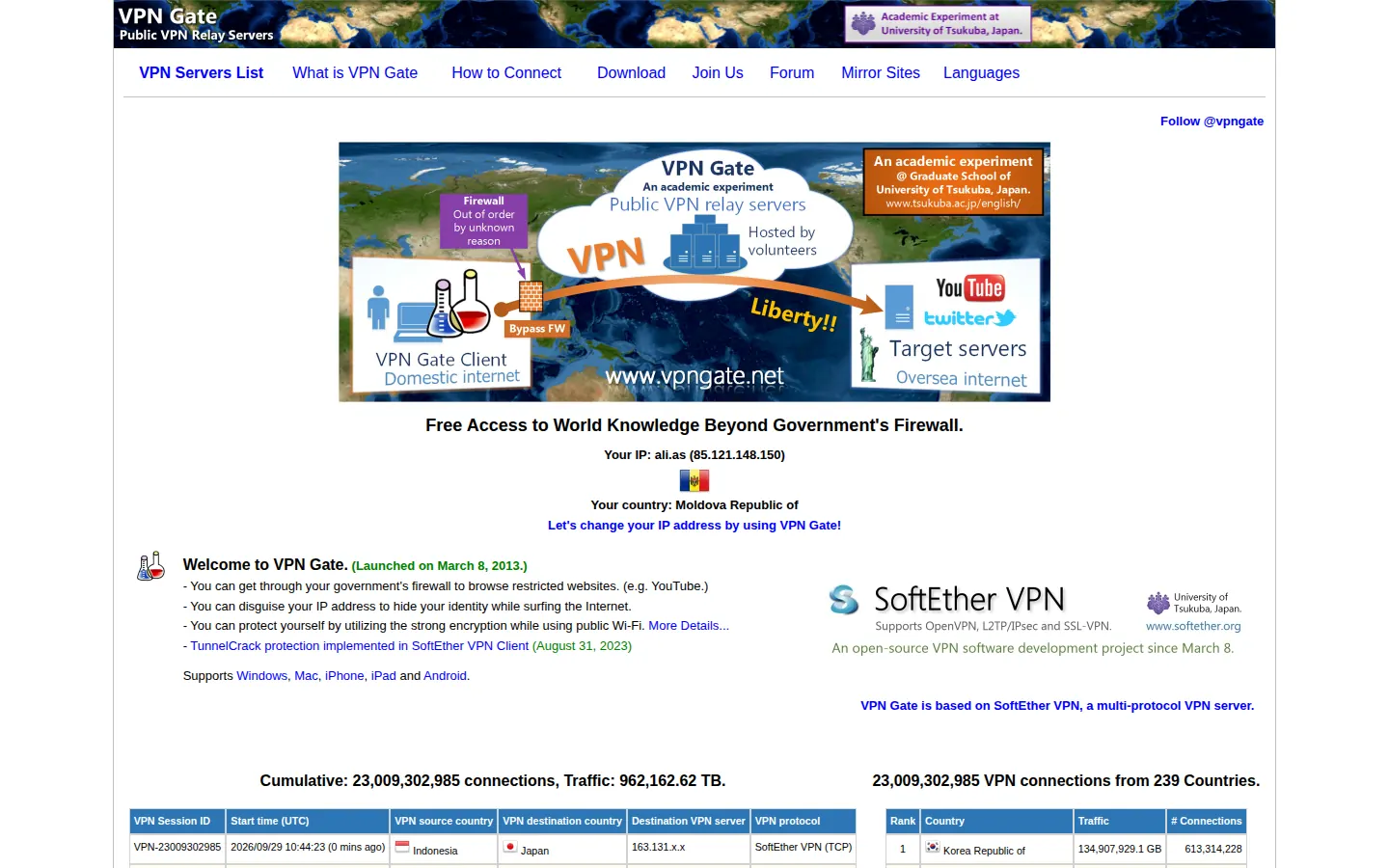
VPN Gate (public volunteer relay experiment) Página de inicio - live capture 2026-09-29
VPN Gate is a free, academic experiment run by the University of Tsukuba, Japan, using volunteer-hosted relays worldwide. It offers no accounts, no payments, and claims to never become a paid service. While genuinely useful for bypassing government firewalls, it openly logs your real IP and the websites you visit for three or more months - making it one of the least private "VPNs" available. This is not a privacy tool; it’s a censorship-escape hatch with full transparency about its surveillance design.
Logging & privacy
VPN Gate explicitly admits to logging: connection timestamps, your real IP and hostname, destination server, protocol, client software, traffic volume, and crucially, the full hostnames (FQDNs) of HTTP/HTTPS sites you visit. These logs are stored for at least three months on servers managed by SoftEther Corporation and disclosed to police, prosecutors, and courts upon legal request. Each volunteer relay also keeps packet header logs for two weeks. The logging claim is policy-only, not audit-backed, and is actively contradicted by the service’s own documentation. Japan’s jurisdiction allows cooperation with authorities, and the project states it will comply with takedown requests. There is no warrant canary.
Pricing & the renewal trap
There is no cost to use VPN Gate - no intro price, no renewal, no fees of any kind. The service is permanently free by policy, citing Japanese university rules and telecom laws. No payment methods are accepted, including cryptocurrency. There is no subscription, so no renewal trap exists. However, the total cost isn’t monetary: you pay with your data, as every connection is logged and potentially disclosed. The derived_pricing fields confirm no cash is required at any point.
VPN Gate supports SoftEther SSL-VPN, L2TP/IPsec, OpenVPN, and MS-SSTP, but offers no kill switch, split tunneling, multihop, or dedicated IP. It does not support P2P or streaming. The network currently runs 101 volunteer relays across 8 countries - far below the "6000+" marketing claim. All major platforms are supported, though iOS users must rely on third-party OpenVPN clients. Performance is unpredictable: speeds, uptime, and availability depend entirely on volunteer hardware and network conditions, with no guarantees. We have not run independent tests.
Ownership & track record
Run by Associate Professor Daiyuu Nobori at the University of Tsukuba, in joint research with SoftEther Corporation. The project is transparent about its structure and logging, but that transparency reveals serious risks: no relay vetting, reliance on untrusted volunteer infrastructure, and a 2018 audit that found 11 vulnerabilities in the underlying SoftEther software. Antivirus software often flags the client. Forum staff openly admit the network is losing ground to state-level blocking. The project’s own users have criticized its logging since 2013, calling it incompatible with privacy.
Censorship resistance
VPN Gate resists censorship not through obfuscation, but through a large, dynamic pool of volunteer IPs and the inclusion of “innocent-looking” addresses in its public list. It uses SSL-VPN over TCP 443 and UDP as its main firewall-piercing method. However, SoftEther forum staff stated in 2026 that “all counter-detection features are completely useless” against modern state-level blocking, advising users to switch to Tor or self-hosted VPS tunnels. While it still works sporadically in censored regions, reliability has sharply declined - especially in Russia and China.
Verdict
Use VPN Gate only if you’re in a censored country and need a free, no-signup way to bypass a firewall - nothing more. It logs your real IP and browsing destinations, hands that data to authorities, and runs on unvetted volunteer servers. It is not safe for privacy, legal sensitivity, or anonymity. The money-trail note: this provider does not pay review sites, as it is a non-commercial academic project with no revenue model.
++ Qué se sostiene
Free forever by design - the FAQ explicitly promises it will 'NEVER be a paying service', and there are no data caps or device limits (Security.org 2026)
No account, no registration, no payment - anonymous connections accepted (FAQ, fetched 2026-11-03)
Rare transparency: the anti-abuse policy states exactly what is logged, and a live anonymized connection-log feed updates every 60 seconds on the site
Four protocols per relay (SoftEther SSL-VPN, L2TP/IPsec, OpenVPN, MS-SSTP) usable from stock OS clients without installing anything on Mac/iOS/Android
Fully open-source stack (SoftEther VPN, Apache-2.0/GPL on GitHub) with an academic pedigree - NSDI'14 paper by the University of Tsukuba authors
Purpose-built censorship resistance: distributed volunteer IPs, mirror sites for when the main site is blocked, and 23.67 billion cumulative connections from 239 countries (counters fetched 2026-11-03)
-- A qué prestar atención
Extensive logging by policy: 3+ months of connection logs including source IP and destination HTTP/HTTPS hostnames (FQDNs), disclosed to police, prosecutors, lawyers and courts on request
Packet logs (all TCP/IP headers) kept 2+ weeks on each volunteer's machine - you are routing traffic through strangers' computers that the project itself warns to treat cautiously
Aggregated log servers are 'owned, operated, and managed by SoftEther Corporation', a commercial joint-research partner, not the university
Tiny real network vs marketing: 101 running relays in 8 countries via the live API on 2026-11-03, most in Japan and South Korea (Security.org concurs: 'Most of the servers are in Japan and South Korea')
Unreliable performance and availability: dynamic IPs, servers 'appear and disappear at any time', and community reports of US servers that 'never work' and speeds that are 'too slow'
No native apps outside Windows, no kill switch/split tunneling/multihop, and no effective obfuscation - forum staff concede counter-detection features are 'completely useless' against modern DPI (March 2026)
Prueba de realidad de precios
Precio inicial
0,00 US$ /mo
Notas
Completely free, no payments of any kind. FAQ (fetched 2026-11-03) states verbatim: 'VPN Gate will NEVER be a paying service in future', citing the Japanese national-university rule against profit activities and the Japanese Telecommunication Law registration burden that would come with a paid network service.
El flujo de dinero - lo que ganan los portales de análisis con esta recomendación
Estado de afiliación aún sin verificar
Si nos uniéramos a este programa, cada enlace de aquí llevaría rel="nofollow sponsored" y pasaría por /go/. Hasta entonces, nuestros enlaces apuntan directamente al sitio del proveedor, sin ningún rastreo. La lógica de ordenación no puede leer físicamente los campos de afiliación - aquí la prueba.
En el sitio web
Capturado por nuestro bot de capturas desde el sitio en vivo (o su archivo público). Una captura es evidencia de lo que mostraba la página en ese momento - no es una recomendación.
VPN Gate (public volunteer relay experiment) Página de inicio - live capture 2026-09-29VPN Gate (public volunteer relay experiment) Aplicaciones - live capture 2026-09-29
Antes de pagar: compruebe el precio de renovación, el plazo de reembolso y si un camino más barato o gratuito cubre su caso de uso - la lista honesta.
Estado de nuestras comprobaciones: 2026-11-03. VPN Gate (public volunteer relay experiment) alcanza 3.7/10 en nuestro análisis ponderado. Hemos registrado 5 señales de alerta (listadas arriba). Los reportes de usuarios, la propiedad y el historial de incidentes están documentados con fuentes fechadas en el metaanálisis de abajo.
What do I actually get with this service?
You get free, accountless access to ~100 volunteer-run relays that may help bypass firewalls, but with no privacy: your IP, browsing destinations, and traffic metadata are logged for 3+ months and shared with authorities.
What is the renewal price and total cost over three years?
There is no renewal price or cost - VPN Gate is permanently free. The `derived_pricing` confirms no cash is required at any time, but your data is the real price.
What evidence supports the no-logs claim?
There is no evidence for a no-logs claim because the provider openly admits to logging. The `logging_evidence` is "policy-only" - a policy that mandates retention of connection logs, destination hostnames, and packet headers.
Does this work in heavily censored countries like China or Iran?
It may work sporadically, but state-level blocking has severely degraded access. Forum staff confirm modern countermeasures are "completely useless" and recommend Tor or self-hosted VPS tunnels instead.
Can I pay anonymously?
No payment is needed - no accounts, no signups, no payment methods accepted. But anonymity ends at connection: your real IP and browsing activity are logged by design.
What happens if the service shuts down?
The FAQ states the project plans to last at least eight years (from 2013), and if it ends, all code will be open-sourced via escrow. No redundancy is promised beyond the administrator.
What’s the honest free or cheap alternative?
For actual privacy, no free alternative is safe. Consider a flat-priced independent provider with audited no-logs policies. For censorship bypass, Tor remains the most trustworthy free option.
El metaanálisis: lo que internet dice de VPN Gate (public volunteer relay experiment)
No esperamos que nos creas. Este análisis es un metaanálisis: abajo verás lo que afirman otros portales de análisis - con sus conflictos de interés señalados -, lo que reportan los usuarios en Reddit y foros y quién opera realmente VPN Gate (public volunteer relay experiment). Cada afirmación enlaza su fuente para que puedas comprobarla tú mismo.
Lo que dicen otros testers (1)
Cada fuente lleva una etiqueta de conflicto de nuestra base de datos de portales de análisis. «Financiado por afiliación» significa: la web gana si tú compras lo que recomienda. Las voces críticas las incluimos deliberadamente.
Fetched 2026-11-03: SecurityScore 7.8/10 by Brett Cruz, updated Sep 10, 2026. Likes: free now and 'will likely always be' free, no data/device limits, strong unblocking for a free VPN. Dislikes: no native apps and complex setup, 'collects and stores activity logs for at least three months' to protect volunteer servers, limited locations ('Most of the servers are in Japan and South Korea'). Bottom line: good day-to-day free option, not for high-level privacy needs.
Lo que dicen los usuarios (6)
Reddit, foros, HN - parafraseado y enlazado, nunca fuera de contexto. Anécdotas, no pruebas - pero las quejas de reembolso y los reportes de fugas son el mejor sistema de alerta temprana que tiene este mercado.
Fetched 2026-11-03: launch-month debate - user FredNelson asks 'DO YOU KEEP LOGS OF WHICH WEBSITES WE VISIT?' and calls the policy incompatible with the project's goals; after no staff reply in 8 days he quits the project; user 'slacka' quotes the log schema (metadata only, no visited-site records) and recommends Tor for privacy; FredNelson replies by quoting the disclosure-to-police clause. A founding-era record of the privacy objection that still applies.
Fetched 2026-11-03: users report that from March 2, 2026 only isolated relays remain reachable ('I can only connect to one single weak server from Vietnam'); staff replies: 'All JP servers work fine. Your government is blocking VPNs. Try UDP.' and 'all counter-detection features are completely useless... Try Tor, your own VPN on a VPS or get Starlink'; one user identifies as being in Russia; another writes 'We are like birds in a cage, and the cage gets smaller every day'.
Fetched 2026-11-03 via arctic-shift archive (reddit.com returns 403 to our fetcher): a user has spent two weeks unable to find a working VPN Gate server to play the Japanese version of a game; replies recommend ovpnspider plus repeated refreshing across IP networks until a key appears, and note iOS is limited to OpenVPN.
Fetched 2026-11-03 via arctic-shift archive: US-listed relays fail with downloaded .ovpn configs; comments confirm 'US servers never work' with both OpenVPN and SoftEther clients, and the one server that connected was 'too slow'.
Fetched 2026-11-03 via arctic-shift archive: describes it as 'a group of volunteers organized and coordinated by Univ of Tsukuba, Japan that run a network of over 4,000 VPN servers world-wide' with 'potential dangers' but possible suitability depending on purpose; counterpoint: 'No one here will ever tell you to use a free VPN. A good VPN is worth every penny.'; another commenter guesses the asker is Iranian because 'thats the only country where vpns are blocked'.
Fetched 2026-11-03: the Reddit JSON endpoints (reddit.com/*.json, old.reddit.com, api.reddit.com) returned HTTP 403 network-policy blocks in this environment, so the three r/VPN and r/PhantomParadeJK threads cited above were read via this public archive API (plus posts searches for 'gate' in r/VPN across 2019-2026).
Informe de hechos con IA - todo lo que sabemos, condensado
Generado por Qwen3 el 2026-11-07 a partir de nuestra base de datos de hechos y las fuentes enlazadas. Resume - no añade hechos. Contraste todo lo importante con las fuentes enlazadas.
Bottom line: VPN Gate is a free, academic censorship-circumvention tool run by the University of Tsukuba, Japan. It works for bypassing government firewalls but offers no real privacy - it logs your real IP and the websites you visit, stores that data for 3+ months, and hands it to authorities. The network is unstable, with only ~100 volunteer relays (not the claimed 6000+), and is actively blocked in many censored regions.
The logging truth: The provider’s no-logs claim is false - it explicitly logs your raw source IP, destination hostnames (FQDNs), connection times, and traffic volume for 3+ months, with logs stored by SoftEther Corporation and disclosed to police, prosecutors, and courts. Jurisdiction is Japan, which it confirms it will comply with under local law.
Pricing reality: It is completely free with no accounts, payments, or data limits. There is no trap - the FAQ states it will never charge, due to university policy and Japanese telecom regulations.
What reviewers say vs what users say: Reviewers (e.g. Security.org, 7.8/10) call it a useful free unblocker but admit it logs activity. Users on Reddit and the SoftEther forum confirm it’s unstable, often blocked, and describe it as a “persistence game” - reviewers appear more optimistic, possibly due to affiliate bias, while real users report sudden outages and failed connections.
Who runs it: Run by Daiyuu Nobori, Ph.D., Associate Professor at the University of Tsukuba, in joint research with SoftEther Corporation. The project is academic, not commercial, but its transparency about logging and cooperation with authorities makes it unsuitable for private or sensitive use.
Fuentes & cómo se hizo este análisis
Cada fuente externa usada en esta página, con su fecha de consulta y su clase de prueba [A]-[D] (A = fuente primaria/del operador, B = prensa seria/investigación, C = comunidad, D = mediciones propias). Metodología: cómo verificamos. Las fuentes desaparecen o cambian - si un enlace está muerto, avísenos por la página de contacto.
Clases de evidencia en esta página:[A] A: 10[B] B: 4[C] C: 6[D] D: 0(D queda vacío hasta nuestra propia fase de pruebas)
Una VPN móvil gratuita de alto nivel de una empresa con sede en Singapur con fortalezas reales sobre el papel: sin necesidad de cuenta, una oferta inusualmente…
AuditoríaAcepta cripto
Inicial: 2,99 US$ /mo
Singapur - LIGHTNINGLINK NETWORKS PTE. LTD. (con su propia política de privacidad y listados en ambas tiendas de aplicaciones; dirección del desarrollador en Play: 8 Marina View #43-01 Asia Square Tower 1, Singapur 018960). Nota: reseñas de 2026 aún describen al operador como 'Free Connected Ltd., una empresa privada con sede en Hong Kong' (Security.org) y 'Con sede en Hong Kong' (Cloudwards), mientras que los documentos oficiales actuales del operador indican Singapur; la migración de entidad está documentada pero la historia corporativa actual no está publicadavpn gratuito hace 4 días
La VPN gratuita más confiable por sus fundamentos estructurales: un colectivo anarquista de Seattle que opera desde 1999, autofinanciado por donaciones, no…
Una herramienta de cifrado gratuita, rápida y de un solo toque que deliberadamente NO es una VPN de anonimato: juzgúela como tal. Los propios documentos de…



Aún no hay comentarios — sé el primero. Publicar pasa por una breve prueba de trabajo en tu navegador (antispam), sin necesidad de cuenta.