nuestra puntuaciónsin valoraciones de usuarios - valore →
Análisis de Snowflake (Tor bridges via volunteer WebRTC proxies)
Snowflake is a bridge, not a tool you 'use' the way you use a VPN: it is the Tor Project's pluggable transport that smuggles Tor connections past censors by disguising them as WebRTC video-call traffic through ~127,000 ephemeral volunteer proxies. Evaluated honestly, it is free, audited (Cure53 reviewed the Snowflake client and Turbo Tunnel in 2021), trivially easy to contribute bandwidth to, and by design keeps no logs - but it is also consistently the first built-in bridge to break under serious censorship: DPI-blocked by Russian ISPs in 2021, domain-front-blocked in Iran in 2023, and reported 'effectively non-functional' in China as of April 2025, while 2026 peer-reviewed research showed AS-level blocking can kill over 30% of the fleet. Use it as one option inside Tor Browser's bridge menu - with WebTunnel and obfs4 as your fallbacks - never as a standalone VPN substitute.
AuditoríaCódigo abierto3 señales de alertaHechos verified - operator pages (snowflake landing page with live proxy count, standalone proxy guide, support portal, about/history, Russia censorship response post), GitLab README via API, Cure53 audit PDF, USENIX Security '24 paper page, arXiv 2026 measurement paper, EFF, OONI, Hacker Factor, net4people/bbs issue, Tor forum thread, HN Algolia threads and Reddit arctic-shift archives all fetched live 2026-11-03; founding year corrected from task premise (2019 was NOT the default-bridge year - that was Tor Browser 10.5 in July 2020; Tor Browser 9.0, Oct 2019, explicitly shipped without it)
Enumeration is not hypothetical: the Sep 2026 arXiv paper (authors include Tor's Cecylia Bocovich) ran 48 days of real-world measurements and enumerated over 21,000 unique proxy IPs across ~1,000 ASNs - and showed blocking the top 1% of ASNs blocks >30% of Snowflakes while affecting 0% of Tranco Top 100 domains, undermining the 'too much collateral damage to block' assumption
The Hacker Factor 'Tor 0day' series (Dec 2021) publicly documented detection methods for Snowflake and other pluggable transports, and Russia's DPI blocking of Snowflake followed the same year - the operator was aware of the weaknesses long before deployment pressures exposed them
Broker centralization: the rendezvous broker is Tor-Project-run and was repeatedly disrupted (front-domain blocks in Iran 2023, broker failure incidents discussed on the Tor forum since 2023) - a single component whose blocking or compromise degrades the whole rendezvous system
Análisis
Borrador de Qwen3, verificado por la redacción de serviciovpn · Versión del análisis 2 · Texto actualizado 2026-11-10 · Hechos a fecha de 2026-11-03 · cómo verificamos
Nota de honestidad: no hemos hecho tests propios de Snowflake (Tor bridges via volunteer WebRTC proxies) (fugas, velocidad, kill switch). Todo en esta página es metainvestigación basada en fuentes con enlaces fechados. En cuanto hagamos pruebas, los resultados aparecerán aquí y en el registro de cambios.
Overview
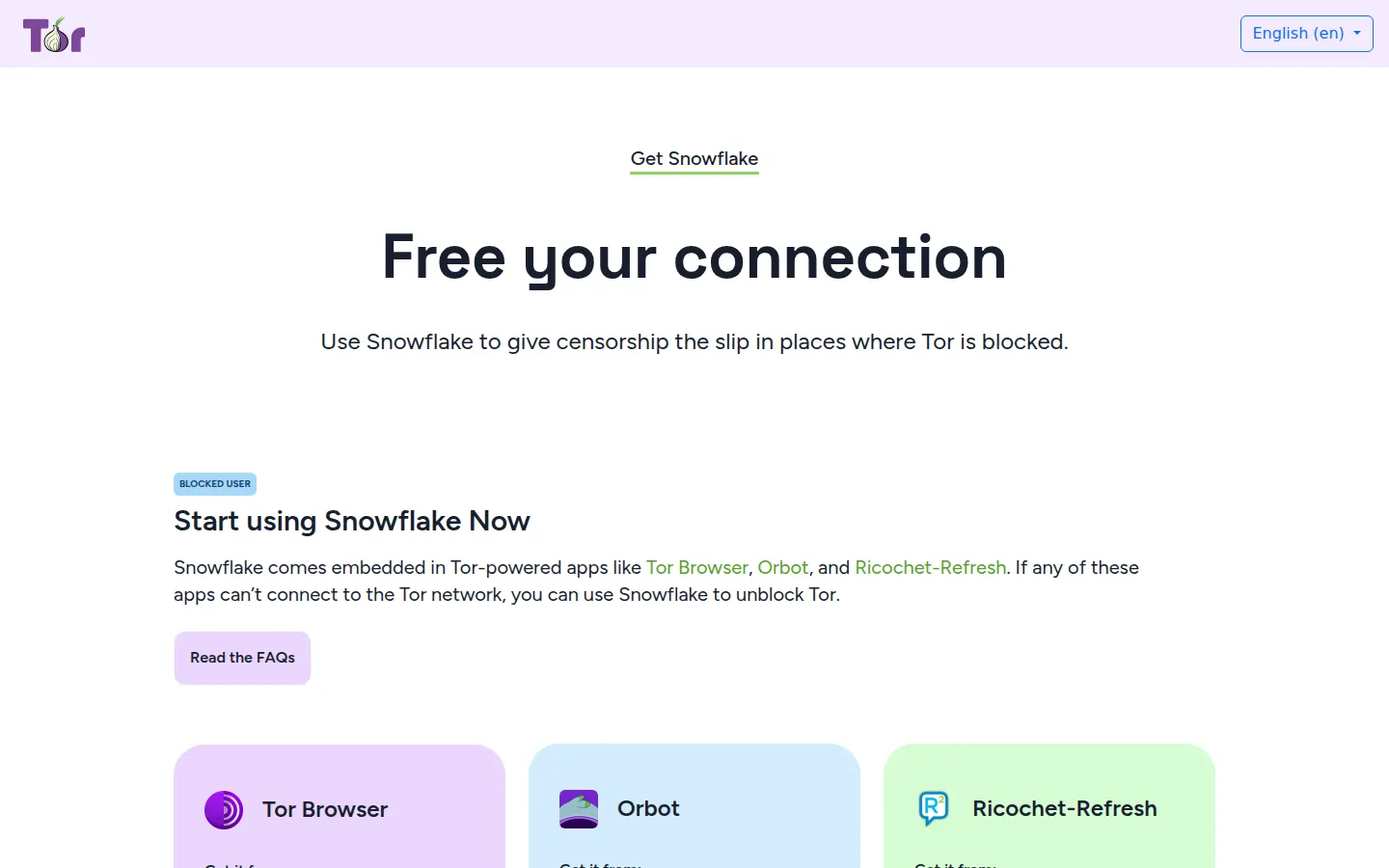
Snowflake (Tor bridges via volunteer WebRTC proxies) Página de inicio - live capture 2026-09-29
Snowflake is a free censorship-evasion tool developed by the Tor Project, not a standalone VPN. It uses volunteer-run WebRTC proxies to help censored users reach the Tor network by disguising traffic as video calls. Run by a U.S.-based nonprofit, it’s designed to be ephemeral and log-free - but it’s also the first bridge to fail under heavy censorship like Russia’s DPI or China’s GFW, with research showing its proxy pool is vulnerable to targeted blocking.
Logging & privacy
Snowflake has no operator logs by design: proxies are stateless, short-lived relays that only forward encrypted Tor traffic and cannot inspect your data. The Tor Project states the proxy sees nothing of your activity, and there’s no account system to tie sessions together. However, the centralized broker knows when and where bridge requests originate, creating a metadata risk. A 2021 Cure53 audit found minor issues but no backdoors, and while the system is open-source and transparent, there’s no court-tested no-logs history - only architectural assurances. Jurisdiction is the U.S., but the real privacy boundary is Tor’s circuit encryption, not Snowflake itself.
Pricing & the renewal trap
Snowflake is completely free - no cost to use, no payment methods, no renewal trap. It’s donation-funded by the Tor Project, with no paid tiers or hidden fees. Volunteers run proxies at no charge, and users pay nothing. The derived_pricing data confirms no billing events, no renewal ratio, and no three-year cost because there is no cost at all. You get full access indefinitely without financial commitment.
Features & performance
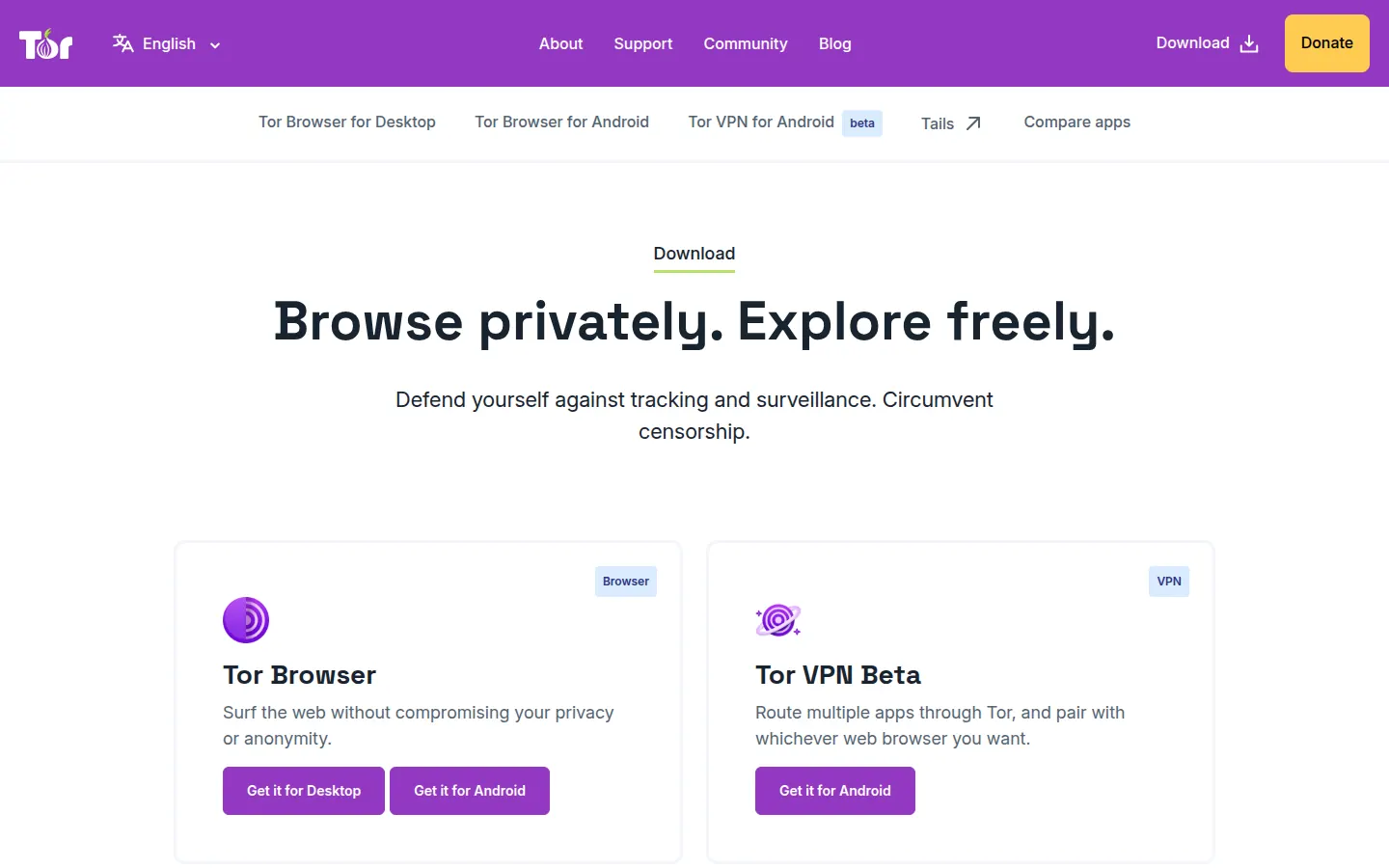
Snowflake (Tor bridges via volunteer WebRTC proxies) Aplicaciones - live capture 2026-09-29
Snowflake uses WebRTC as a pluggable transport to disguise Tor traffic as peer-to-peer video calls, with no kill switch, split tunneling, or multihop. It’s built into Tor Browser, Orbot, and Ricochet-Refresh for Windows, Mac, Linux, Android, and iOS. There are no performance claims we can verify independently - this tool doesn’t offer speed, streaming, or P2P. Its purpose is access, not performance. With no server count or country metrics, and no self-testing done, its value lies in obfuscation, not bandwidth.
Ownership & track record
Snowflake is run by the Tor Project, a U.S. 501(c)(3) nonprofit focused on digital rights and anonymity. No corporate ownership or affiliate ties exist. However, red flags include documented enumeration attacks - peer-reviewed research in 2026 showed over 21,000 proxies mapped in 48 days, with top ASNs blocking over 30% of the network. The broker has been disrupted by domain blocks in Iran, and detection methods were public as early as 2021. Despite active development and community trust, its technical fragility under sustained censorship is well-documented by OONI, EFF, and the Tor team itself.
Censorship resistance
Snowflake resists censorship by mimicking WebRTC video traffic and using domain fronting via Fastly (cdn.sstatic.net) to hide broker communications. But this is brittle: Iran blocked the front domain in 2023, cutting usage by 20%, and Russia DPI-blocked Snowflake in 2021. By April 2025, users in China reported it “effectively non-functional.” While proxy churn helps, research proves AS-level blocking can disable large swaths of the network with minimal collateral damage. If you’re in China, Iran, or Russia, Snowflake may fail quickly - use it as a first try, not a guarantee.
Verdict
Use Snowflake only as a built-in bridge in Tor Browser or Orbot if you’re in a censored region - it’s free, easy, and part of a vital resistance network. But don’t rely on it under heavy censorship; it breaks first and often. For volunteers, running a proxy is a meaningful act of solidarity. The money trail is clean: no affiliate programs, no payments, no profit - just a nonprofit fighting for open access.
++ Qué se sostiene
Completely free, donation-funded, no account - both for censored users and for volunteers donating bandwidth
Massive volunteer fleet: 127,599 live Snowflake proxies counted on the official landing page (2026-11-03); ephemeral proxies resist IP enumeration by design
Cleverly disguised as WebRTC video-call traffic, making naive blocking costly (blocking it means blocking videoconferencing-like traffic)
The client code has been third-party reviewed: Cure53's 2021 UC Berkeley-commissioned audit covered the Snowflake client library and Turbo Tunnel (findings were minor: one Low memory leak, one Info rate-limiting gap)
Zero-log design: ephemeral proxies cannot observe client traffic and keep nothing; no accounts exist to subpoena
One-click contribution: browser extension, Docker, Debian/FreeBSD packages make helping censored users genuinely easy (EFF: 'anyone can run a pluggable transport in their browser with just a couple of clicks')
-- A qué prestar atención
It only connects you to Tor - it is not a standalone VPN and cannot hide you from the sites you visit; anonymity comes from Tor's circuits, not Snowflake
Slow: traffic flows through volunteer home connections and then the full Tor network; proxy connections are short-lived and can drop mid-session
Real-world blocking record: DPI-blocked by Russian ISPs (Dec 2021), domain-front blocked in Iran (Jan 2023, ~20% user drop), and 'effectively non-functional' in China per an April 2025 report to the Tor forum
2026 peer-reviewed research (with Tor Project's own Cecylia Bocovich as co-author) demonstrated practical enumeration of 21,000+ proxy IPs and an AS-level blocking strategy cutting >30% of Snowflakes
Dependence on domain fronting through third-party CDNs (Fastly, formerly Google) is a structural fragility - front domains get blocked and Tor must keep moving
No warrant canary from the Tor Project; the broker is a centralized rendezvous point whose traffic patterns a determined adversary can observe
Prueba de realidad de precios
Precio inicial
0,00 US$ /mo
Notas
Free, donation-funded: nothing to buy at any tier. Developed and operated by the Tor Project, which is funded by donations ('Unlike Big Tech, Tor doesn't sell your data to make money. Instead, 6,490 donors every year keep Tor strong' - site banner, fetched 2026-11-03)
Comprueba el precio de renovación arriba antes de cualquier plan plurianual - calculadora de costes.
¿Es fiable Snowflake?
Domicilio legal: United States - The Tor Project, Inc., a 501(c)(3) nonprofit since 2006 ('became a 501(c)(3) nonprofit in 2006' per torproject.org/about); Snowflake code and broker infrastructure are run by the Tor Project's Anti-Censorship team; volunteer proxies are worldwide. Declaración de registros: No operator logs by design: proxies are 'lightweight, ephemeral' and see only encrypted Tor traffic - 'The Snowflake client will not be able to interact with your computer in any way or observe your network traffic, and you will not be able to see their traffic' (Tor Project messaging via EFF, fetched 2026-11-03); there is no user account, no session store, and nothing to retain - clase de evidencia: sin afirmación de «sin registros». Sin incidentes registrados en nuestra investigación - la ausencia de evidencia no es prueba de inocencia. Datos verified - operator pages (snowflake landing page with live proxy count, standalone proxy guide, support portal, about/history, Russia censorship response post), GitLab README via API, Cure53 audit PDF, USENIX Security '24 paper page, arXiv 2026 measurement paper, EFF, OONI, Hacker Factor, net4people/bbs issue, Tor forum thread, HN Algolia threads and Reddit arctic-shift archives all fetched live 2026-11-03; founding year corrected from task premise (2019 was NOT the default-bridge year - that was Tor Browser 10.5 in July 2020; Tor Browser 9.0, Oct 2019, explicitly shipped without it) (no totalmente verificados) a fecha de 2026-11-03 - lee las fuentes abajo.
El flujo de dinero - lo que ganan los portales de análisis con esta recomendación
Estado de afiliación aún sin verificar
Si nos uniéramos a este programa, cada enlace de aquí llevaría rel="nofollow sponsored" y pasaría por /go/. Hasta entonces, nuestros enlaces apuntan directamente al sitio del proveedor, sin ningún rastreo. La lógica de ordenación no puede leer físicamente los campos de afiliación - aquí la prueba.
En el sitio web
Capturado por nuestro bot de capturas desde el sitio en vivo (o su archivo público). Una captura es evidencia de lo que mostraba la página en ese momento - no es una recomendación.
Snowflake (Tor bridges via volunteer WebRTC proxies) Página de inicio - live capture 2026-09-29Snowflake (Tor bridges via volunteer WebRTC proxies) Aplicaciones - live capture 2026-09-29
Antes de pagar: compruebe el precio de renovación, el plazo de reembolso y si un camino más barato o gratuito cubre su caso de uso - la lista honesta.
¿Es Snowflake (Tor bridges via volunteer WebRTC proxies) fiable?
Estado de nuestras comprobaciones: 2026-11-03. Snowflake (Tor bridges via volunteer WebRTC proxies) alcanza 3/10 en nuestro análisis ponderado. Hemos registrado 3 señales de alerta (listadas arriba). Los reportes de usuarios, la propiedad y el historial de incidentes están documentados con fuentes fechadas en el metaanálisis de abajo.
What do I actually get with Snowflake?
You get a free, built-in bridge in Tor Browser that routes your connection through ephemeral WebRTC proxies to bypass censorship. It’s not a standalone app or VPN - just a way to reach Tor when direct access is blocked.
What is the renewal price and total 3-year cost?
There is no renewal price and no cost at all. Snowflake is completely free, donation-funded, with no billing, no subscription, and no fees - ever. The three-year cash total is $0.
What evidence supports the no-logs claim?
Snowflake can’t log user activity by design - proxies are stateless and see only encrypted traffic. But the broker knows when and where bridge requests come from. There’s no court-tested proof, only architecture and audits: Cure53 reviewed the code in 2021 and found no logging mechanisms.
Does it work in censored countries like China or Iran?
Sometimes, but not reliably. It failed under Russian DPI in 2021, was hit by Iran’s domain blocks in 2023, and was reported “effectively non-functional” in China by 2025. Use it as a first attempt, but have WebTunnel or obfs4 ready as fallbacks.
Can I pay anonymously or avoid identification?
No payment is needed, and no account exists - just install Tor Browser and enable Snowflake. Your identity isn’t collected, but your traffic metadata (timing, volume) may be visible to the broker and your ISP.
What happens if Snowflake shuts down?
If the broker or network fails, you lose this bridge option. The Tor Project would likely promote alternatives like WebTunnel or meek. Since it’s open-source, forks could emerge, but continuity isn’t guaranteed - always have backup bridges ready.
What’s the honest free or cheap alternative?
Stick with Tor Browser and try other built-in bridges: WebTunnel, meek-azure, or obfs4. For non-Tor use, consider Outline (free, self-hosted) or a flat-priced independent VPN like Mullvad - but only if you need consistent access Snowflake can’t provide.
El metaanálisis: lo que internet dice de Snowflake (Tor bridges via volunteer WebRTC proxies)
No esperamos que nos creas. Este análisis es un metaanálisis: abajo verás lo que afirman otros portales de análisis - con sus conflictos de interés señalados -, lo que reportan los usuarios en Reddit y foros y quién opera realmente Snowflake (Tor bridges via volunteer WebRTC proxies). Cada afirmación enlaza su fuente para que puedas comprobarla tú mismo.
Lo que dicen otros testers (3)
Cada fuente lleva una etiqueta de conflicto de nuestra base de datos de portales de análisis. «Financiado por afiliación» significa: la web gana si tú compras lo que recomienda. Las voces críticas las incluimos deliberadamente.
Fetched 2026-11-03 (PDF): commissioned by UC Berkeley, Jan 2021; scope explicitly included 'White-Box Tests and Source Code review of Snowflake' from gitweb.torproject.org/pluggable-transports/snowflake.git; findings UCB-02-001 memory leak in Snowflake client Handler() (Low), UCB-02-008 lack of server-side rate limiting in Snowflake and dnstt (Info); noted brokers/proxies are not authenticated - the only public third-party security review of Snowflake code.
Fetched 2026-11-03: by Cecylia Bocovich (Tor Project), Arlo Breault, David Fifield, Serene, Xiaokang Wang; 'blocking resistance comes from the use of numerous, ultra-light, temporary proxies (snowflakes)' forwardable to a centralized bridge; proxies simple enough for JavaScript; large changing pool resists enumeration; 'deployed with success in Tor Browser and Orbot for several years'.
Fetched 2026-11-03: over 48 days (May-June 2025) a malicious-client attack enumerated over 21,000 unique proxy IPs across almost 1,000 ASNs; proxy churn limits per-IP damage, but blocking the top 1% of observed ASNs blocks >30% of observed Snowflakes while affecting 0% of Tranco Top 100 and ~2.5% of Top 1M domains - directly challenging Snowflake's collateral-damage assumption; co-author Cecylia Bocovich is the Tor Project's Snowflake lead.
Lo que dicen los usuarios (6)
Reddit, foros, HN - parafraseado y enlazado, nunca fuera de contexto. Anécdotas, no pruebas - pero las quejas de reembolso y los reportes de fugas son el mejor sistema de alerta temprana que tiene este mercado.
Fetched 2026-11-03 via GitHub API: Snowflake users dropped ~20% in five days (since 2023-01-16) after Iran's ISPs blocked cdn.sstatic.net, the default front domain; two rendezvous methods (domain fronting, AMP cache) and their workarounds documented; demonstrates how fragile CDN-fronted rendezvous is in practice.
Fetched 2026-11-03: user in China reports obfs4, meek-azure and Snowflake 'effectively non-functional', connections blocked within minutes to hours; Tor team member dcf replies asking for versions and notes recent Snowflake configuration changes plus that Tor Metrics still shows China-based Snowflake users.
Thread fetched 2026-11-03 via HN Algolia items API: multi-year proxy volunteers, tab-pinning usability complaints, addon recommendation, NAT/TURN technical questions, reassurance that snowflake proxies are intermediaries not exits, and one skeptic citing nusenu's Tor relay-actor concerns.
Thread fetched 2026-11-03 via HN Algolia items API: deep-dive on the domain-fronting dependence (Fastly/cdn.sstatic.net default, formerly Google), concern that front-based rendezvous is 'quickly becoming non-viable', operator-risk clarification from official docs, and a request for Docker monitoring tooling.
Fetched 2026-11-03 (20 comments, Oct 15-Nov 1 2026): users cycling bridges by transport order (Snowflake, WebTunnel, Meek, obfs4), suspicion of broker-probing censors, usage spikes tracking national blocking waves, Orbot snowflake-mode volunteers reporting 8k-17k people helped, and beginners asking what Snowflake even is.
Fetched 2026-11-03: 20 story hits spanning 2019-2026 including 'Tell HN: Help censored users access Tor' (2019), Russia-censorship threads (2022), the bridge enumeration attack story (2023-01-31), 'Sustaining Tor Snowflake bridge operations' (2023-02-08), and renewed calls for proxies in Jan-Feb 2026 - showing recurring volunteer-shortage cycles.
Informe de hechos con IA - todo lo que sabemos, condensado
Generado por Qwen3 el 2026-11-10 a partir de nuestra base de datos de hechos y las fuentes enlazadas. Resume - no añade hechos. Contraste todo lo importante con las fuentes enlazadas.
Bottom line: Snowflake is not a subscription service or standalone VPN - it is a free, built-in Tor bridge that disguises Tor traffic as WebRTC video calls through ~127,599 volunteer proxies. It is easy to use and contributes to censorship resistance, but it is often the first bridge to fail under active DPI or domain blocking, as seen in Russia, Iran, and China. Treat it as a first-try option within Tor Browser, not a reliable standalone solution.
The logging truth: No operator logs are possible by design - proxies are ephemeral and only relay encrypted Tor traffic. The Tor Project, based in the United States, runs the central broker but cannot decrypt user data. However, the broker sees client connection attempts and proxy assignments, creating metadata exposure if compromised.
Pricing reality: It is completely free - no cost to use, no renewal, no payment. Funded by donations to the Tor Project, there is no pricing trap because there is no commercial product.
What reviewers say vs what users say: Reviewers like EFF praise its accessibility and volunteer model, calling it easy for anyone to support. But users in censored regions and researchers (including Tor’s own team) report it fails quickly under GFW or DPI, with arXiv 2026 proving Snowflake is vulnerable to large-scale proxy enumeration and targeted blocking - conflicting with optimistic narratives.
Who runs it: The Tor Project, a U.S.-based nonprofit, develops and operates Snowflake’s core infrastructure. Volunteers worldwide run the proxies, but the centralized broker remains a single point of failure, as seen in past Iran and Russia disruptions.
Fuentes & cómo se hizo este análisis
Cada fuente externa usada en esta página, con su fecha de consulta y su clase de prueba [A]-[D] (A = fuente primaria/del operador, B = prensa seria/investigación, C = comunidad, D = mediciones propias). Metodología: cómo verificamos. Las fuentes desaparecen o cambian - si un enlace está muerto, avísenos por la página de contacto.
Clases de evidencia en esta página:[A] A: 6[B] B: 6[C] C: 6[D] D: 0(D queda vacío hasta nuestra propia fase de pruebas)
Valorar Snowflake (Tor bridges via volunteer WebRTC proxies)
Valoración de la comunidad: aún sin valoraciones
Una valoración por usuario y proveedor. La visualización suavizada (prior estadístico) evita la manipulación de un solo voto.
Comentarios de usuarios (0)
Aún no hay comentarios — sé el primero. Publicar pasa por una breve prueba de trabajo en tu navegador (antispam), sin necesidad de cuenta.
Alternativas a Snowflake (mismo tipo)
Solo proveedores comparables del mismo tipo - una app gratuita nunca es "la alternativa" a una VPN comercial. Rankeados con la misma puntuación determinista.
Una herramienta para eludir la censura que ahora adopta el ropaje de una organización sin ánimo de lucro: la entidad matriz de Lantern se convirtió en el…
CanaryCódigo abierto
Inicial: 3,63 US$ /mo
Estados Unidosherramienta de privacidad hace 43 días
Un servicio de filtrado a nivel de DNS que ha crecido a la vista del público: nacido entre enero y abril de 2021 del equipo de Windscribe (los mismos tres…
Código abierto
Inicial: 3,00 US$ /mo
Canadá - CONTROLD, Inc., Toronto, Ontario; la página 'sobre nosotros' del operador indica 'Fundada en 2021 - Toronto, Canadá' y el pie de página del sitio dice '2026 CONTROLD, Inc.'; la FAQ de free-dns la describe como 'con sede en Toronto, Canadá... la empresa hermana de Windscribe'herramienta de privacidad hace 7 días
Hysteria 2 no es un proveedor de VPN; es un software proxy gratuito con licencia MIT que usted implementa en su propio servidor, y este informe lo trata como…
Código abierto
Inicial: 5,00 US$ /mo
ninguna - Hysteria no es una empresa; es un software de código abierto con licencia MIT (Go) desarrollado por una comunidad de voluntarios alrededor del desarrollador principal 'Toby' (GitHub: tobyxdd), con el repositorio en GitHub y la documentación en hysteria.networkherramienta de privacidad hace 7 días


Aún no hay comentarios — sé el primero. Publicar pasa por una breve prueba de trabajo en tu navegador (antispam), sin necesidad de cuenta.